Plumbing in Hennepin County, the short answer
PlumbTek plumbs homes in Hennepin County, from Minneapolis, the county seat (55415), out through Bloomington, Richfield, St. Louis Park, Edina, Plymouth, Minnetonka and Maple Grove. In the city, expect sewer lateral work and galvanized line swaps. Farther west, the calls lean toward softeners, sump pumps and ejector pumps.
How does plumbing change from Minneapolis to the western suburbs?
Inside Minneapolis, much of the housing went up between the 1880s and 1940s. Those houses tend to carry galvanized steel supply pipe, cast iron drain stacks and clay tile sewer laterals with joints that loosen over time. Roots from boulevard elms and maples find those gaps. Many pre-1950 homes still take water through a lead service line, and the city runs a replacement program with an address lookup.
Cross into St. Louis Park, Richfield or Bloomington and the houses get younger: post-war ramblers and split-levels with original cast iron, early copper and water heaters squeezed into closets built for smaller tanks. Out in Plymouth, Eden Prairie and Maple Grove, newer subdivisions bring long hot water runs, finished basements with ejector pumps, and hard water that keeps a softener busy.

Which sewer problems show up most in older Hennepin County homes?
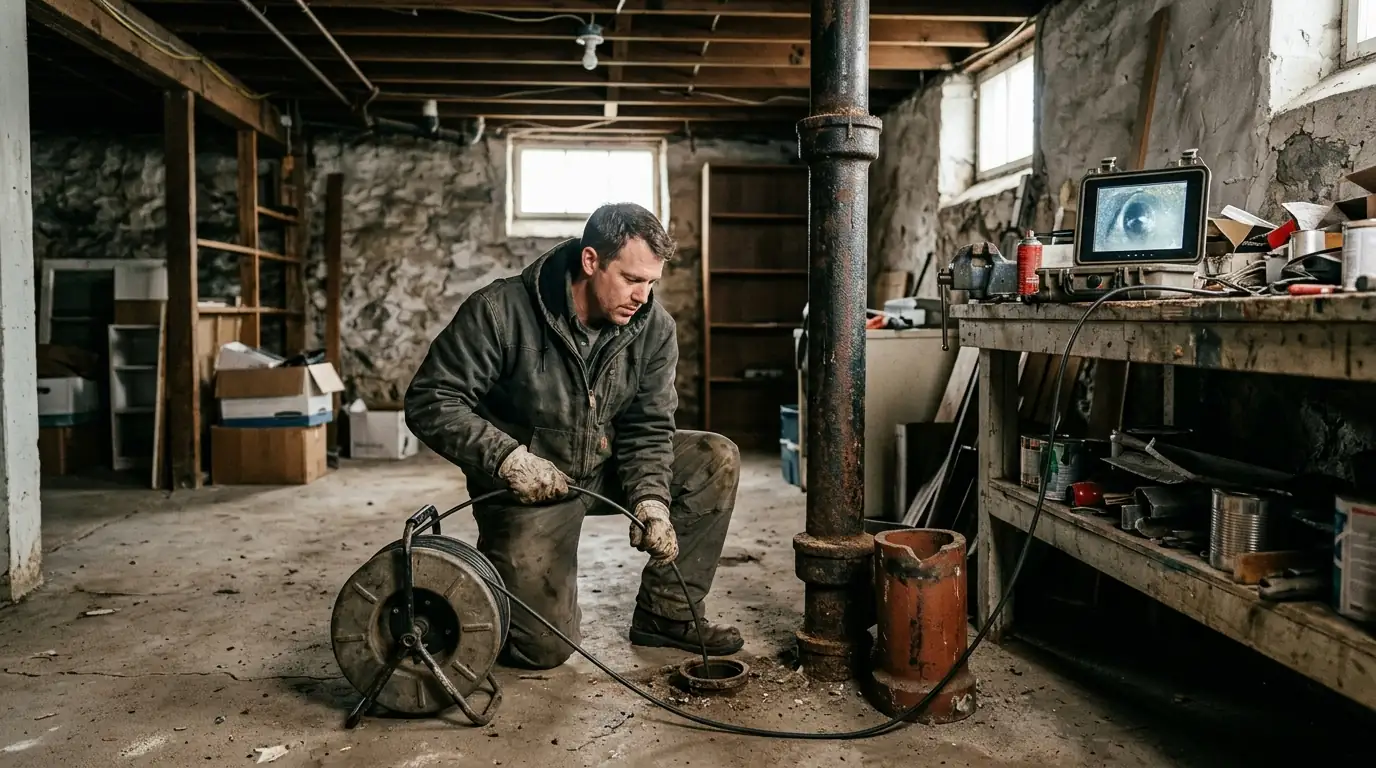
You own the sewer lateral from your house to the city main, and in the older parts of the county that pipe is usually clay tile. When a basement floor drain gurgles or backs up after a heavy rain, roots and offset joints are the usual suspects. A camera run down the line shows exactly where the trouble sits and how far it is from the foundation.
When PlumbTek finds a lateral that's cracked, sagging or packed with roots, the choices get laid out plainly: clear the roots and keep an eye on it, fix one bad section, line the pipe trenchless where the run allows, or dig and replace. The price of each path is explained before work starts, and the permits the job needs get pulled.
What does a Hennepin County winter do to the water lines?
Water service lines here are buried well below the frost line, so the street side usually holds. The trouble starts indoors, where pipes run through exterior walls, rim joists, attached garages and three-season porches. A January cold snap freezes them, and the split often shows itself only when the ice lets go and water starts running across a finished basement floor.
Older city homes add another weak spot: a gate-style main shut-off valve that hasn't been turned in decades. If it seizes or snaps the moment you need it, a small leak turns into a soaked floor. A quarter-turn ball valve is a short swap, far better done in October than mid-burst.
Practical habits for Hennepin County houses
- Test the main shut-off in fall. Go to the basement wall where the water line enters and turn the valve gently. If it won't budge or weeps at the stem, plan a replacement before the next freeze.
- Know which pipe is yours. The sewer from your foundation to the city main belongs to you. A camera check before buying or after a backup tells you its condition without any guessing.
- Drain the garage hose bib. Attached garages often have an outdoor faucet fed by a line in a cold wall. Close the inside valve each fall and open the spout so the line can drain.
- Look up your service line. If your Minneapolis house was built before 1950, use the city address lookup to see whether a lead service line is on record before you spend money on filters.