Hydro jetting in Minneapolis, the short answer
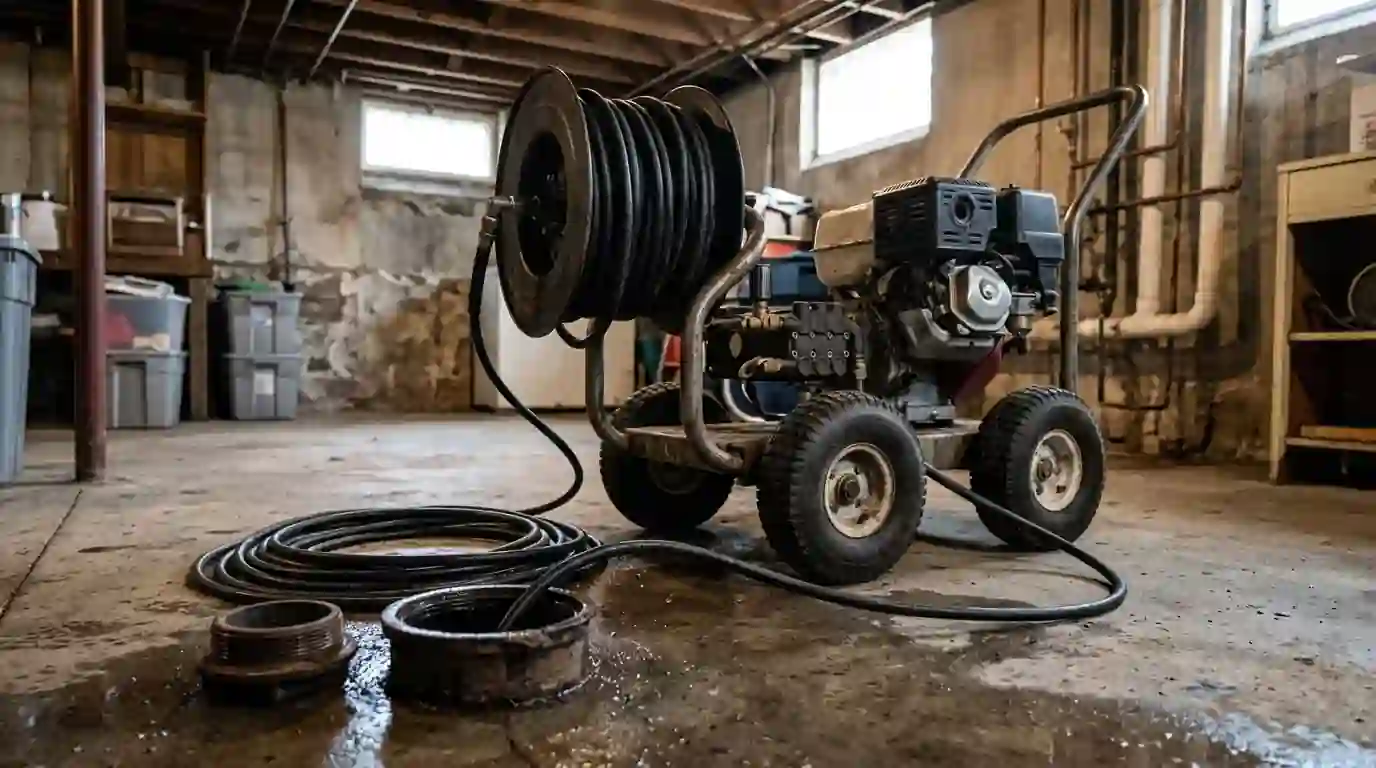
Hydro jetting in Minneapolis is a drain and sewer cleaning method that sends water at very high pressure through a hose and rotating nozzle to strip buildup from the entire inside of the pipe. You need it when a line clogs repeatedly after cabling, carries heavy kitchen grease, or holds fine root growth. It's done after a camera check confirms the pipe is sound enough to take the pressure.
Why a cable leaves buildup behind and a jet doesn't
A cable machine bores a path through a clog roughly the width of its cutter. That reopens the drain, but grease coating the pipe wall, scale ridges in cast iron and fine root hair stay put. The new buildup catches on the old, and in a busy kitchen line you can be back to a slow drain within a season.
A jetting nozzle works differently. Rear-facing jets pull the hose forward while spraying the pipe wall at a steep angle, and a forward jet breaks up anything blocking the path. The water scours the full circumference of the pipe and carries the loosened material downstream to the city main, so the line ends up close to its original bore.
Which pipes should not be jetted
Jetting is safe for sound PVC, ABS, copper and cast iron in fair condition. It's not right for every pipe. Clay tile with offset joints or missing pieces can lose more of its wall, and cast iron rusted down to a thin channel along the bottom can blow through. Orangeburg fiber pipe, found in some 1950s and 1960s suburbs, should not be jetted at all.
That's why we run a camera before jetting any main line we haven't seen. If the pipe looks fragile, we'll lower the pressure, choose a gentler nozzle or tell you jetting isn't worth the risk. Sometimes the honest answer is that the line needs repair first, and cleaning it hard would only speed that along.
Jobs where jetting pays off
Kitchen lines in homes where someone cooks a lot are the classic case, especially long runs from an island sink to the stack. Jetting also works well on main sewer lines with a light root mat, basement floor drains packed with silt and sand, and laundry lines heavy with lint and detergent sludge.
For duplexes and small apartment buildings in Uptown, Whittier or Saint Paul's Frogtown, several units share one building drain, so a slow line affects everyone. Jetting that shared line on a regular schedule, sometimes once a year, costs less than repeated emergency calls when it backs up into a ground floor unit.
When a line is ready for jetting instead of cabling
These patterns usually mean the pipe wall itself is coated, not just plugged.
- Clogs return within a few monthsIf the same drain needed cabling twice in a year, buildup on the pipe wall is likely catching new debris every time water runs.
- Grease chunks in the cleanoutWaxy white or tan lumps at the cleanout or in the floor drain mean grease has coated a long stretch of the line.
- Fine roots after cuttingA cutter head removes thick roots but leaves a fuzzy root mat, which jetting can strip much more completely.
- Sand or silt in the floor drainFloor drains that collect sand from foundation seepage or a washed-out tile pack solid in ways a cable only pokes through.
- Scale ridges on the cameraTuberculation, the rusty ridges inside old cast iron, narrows the pipe and traps paper and grease until it's cleared off.
How a hydro jetting job runs, step by step
Camera the line first
We run a camera from the cleanout to see pipe material, joint condition and what the buildup is, so pressure and nozzle choice fit the actual pipe.
Protect the work area
We lay drop cloths, set up at the cleanout or roof vent, and check that fixtures upstream won't send water back at you during jetting.
Jet in controlled passes
The nozzle goes out in stages and is pulled back slowly, scouring each section before moving on and letting the debris flush toward the main.
Camera again to confirm
A second camera pass shows the cleaned pipe wall, and you can see the before and after on the screen yourself.
Talk through maintenance
We explain whether this line needs a jetting interval, a repair at a bad joint or nothing further for now.
Jetting rates for kitchens, mains and shared building drains
Jetting costs more than cabling because it takes heavier equipment and a camera check. Your house sets the final number, and you get the figure ahead of the work.
| Job | Typical range | What moves the price |
|---|---|---|
| Kitchen or branch line jetting | $389 to $676 | Line length, grease depth and access through a cleanout |
| Main sewer line jetting with camera | $587 to $1,135 | Distance to the city main and amount of root mat |
| Floor drain and basement line jetting | $437 to $812 | Sand or silt volume and condition of the drain body |
| Shared building drain, two to four units | $714 to $1,428 | Number of stacks, access points and buildup level |
What changes the number
- Whether a usable cleanout exists or access has to come through a toilet or roof vent.
- How far the line runs and how many bends the nozzle must turn.
- The type of buildup, since hardened grease and dense roots take more passes.
- Whether the line needs a camera check before and after, which we recommend on main lines.
- Time of day, since after-hours jetting calls cost more.
Ranges reflect typical Twin Cities jobs in 2026. Your price is explained before work starts. Compare other jobs in the PlumbTek price guide.
Cabling or jetting: how they compare on the same pipe
| Point | Cable machine | Hydro jetting |
|---|---|---|
| What it clears | A path through the clog about the width of the cutter | Buildup from the whole pipe wall, not just the center |
| Best for | Hair, paper and one-off clogs in branch drains | Grease, scale, sludge and fine roots on long runs |
| Pipe condition needed | Works on most pipes, including older ones with care | Needs sound pipe confirmed by camera first |
| How long results last | Months on a coated line, longer on clean pipe | Often a year or more before buildup returns |
| Typical cost | Lower, a single tech and smaller machine | Higher, heavier equipment plus camera time |
What Twin Cities pipes look like before jetting
Inside a century-old cast iron building drain in Powderhorn or Corcoran, the camera usually shows rusty tuberculation along the walls with paper and grease caught on it. The pipe may still have plenty of life, and jetting clears the ridges without the stress of digging. Clay laterals from the same era often show roots at every joint.
Restaurants and busy households near Lake Street and Eat Street put heavy grease loads into old lines. In newer suburbs like Plymouth and Lakeville, PVC mains rarely need jetting unless a long kitchen run collects grease or construction debris was left in the line when the house was built.