Faucet repair in Minneapolis, the short answer
Faucet repair in Minneapolis means fixing a kitchen, bathroom or laundry faucet that drips, leaks at the handle or base, sprays unevenly, or has lost pressure. Most repairs replace a cartridge, compression washer, valve seat, O-rings or aerator. You need it as soon as a drip starts, since worn seals only get worse and steady drips waste more water than most people expect.
Which kind of faucet do you have?
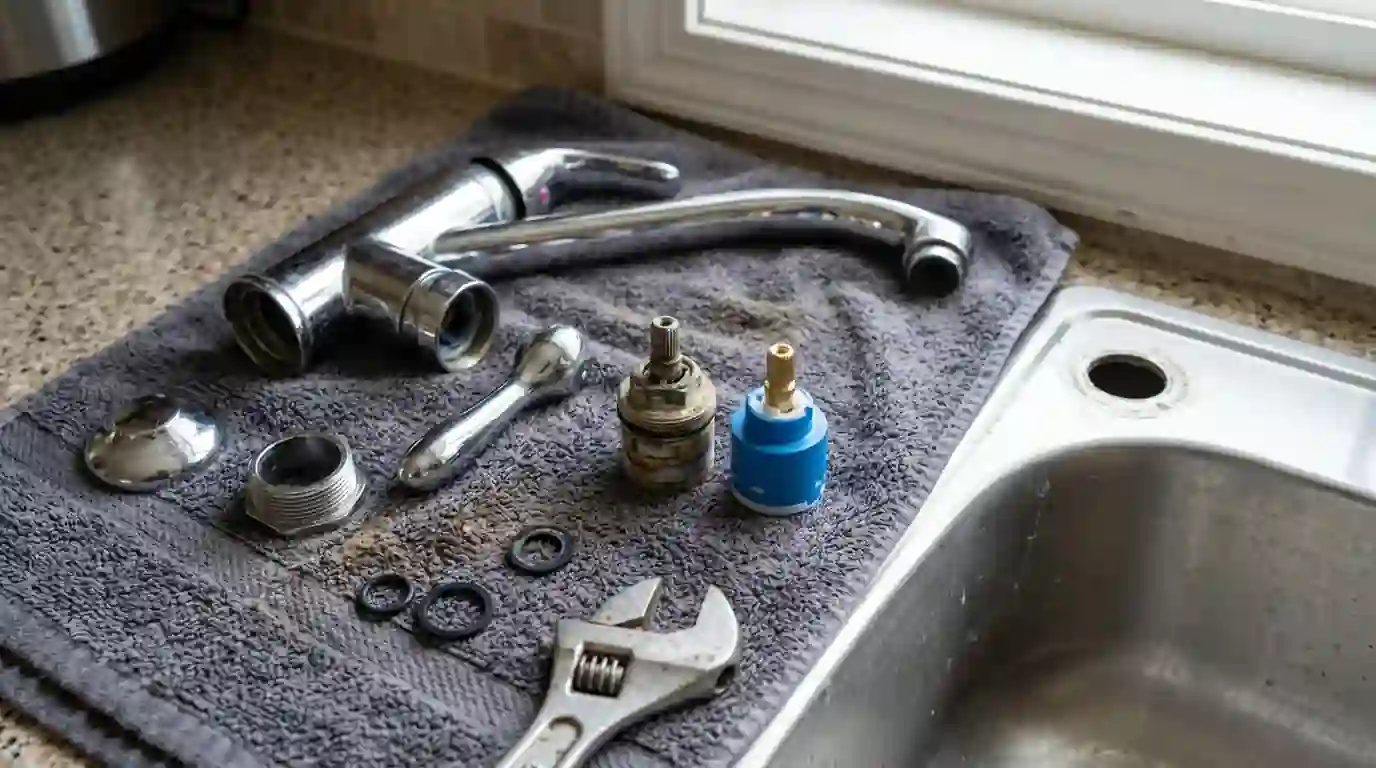
The repair depends on what's inside the handle. Older two-handle faucets, common in pre-war Minneapolis bathrooms, are compression faucets: turning the handle presses a rubber washer down onto a brass seat. When either wears, water slips past and drips from the spout. Those faucets are very repairable, and the parts cost little.
Most faucets sold since the 1990s use a cartridge, a ceramic disc valve, or a ball valve. Single-handle kitchen faucets usually have a cartridge specific to the brand and model. The right replacement matters, because a close match that's slightly off will leak or limit hot water. The plumber pulls the old cartridge and matches it before ordering anything.
Where the water is leaking changes the fix
A drip from the spout means the internal seal isn't closing, so it's the washer, seat or cartridge. Water pooling around the base of a kitchen faucet usually comes from worn O-rings on the swivel spout. A leak under the sink often traces to a loose supply connection, a cracked supply line, or a pull-down hose that has worn through where it rubs the cabinet.
Leaks around the handle point to a packing nut or stem O-ring on a compression valve, or a cracked cartridge body. Some of these are five minute fixes once the right part is in hand. Others reveal a corroded valve body, and then replacing the faucet is the better use of your money.
Low flow is usually debris, not the faucet
When one faucet suddenly runs weak, the aerator screen at the spout is often packed with grit. That's common after the city flushes hydrants, after a water main repair nearby, or after a plumber shuts off and restarts your water. Older galvanized supply lines also shed rust flakes that collect in aerators and cartridge inlets.
If cleaning the aerator doesn't help, PlumbTek checks the cartridge inlet screens and the stop valves under the sink. Old multi-turn stops can partly close with scale. When every faucet in the house is weak, the problem lies upstream, often in corroded galvanized pipe, and that's a different conversation.
Signs a faucet is ready for repair
Most faucet problems start small, and fixing them early is cheaper than waiting.
- Steady drip from the spoutA worn washer, seat or cartridge lets water past even when the handle is fully closed. It gets faster over time.
- Handle stiff or grindingMineral buildup or a dried-out cartridge makes the handle hard to turn and usually means the cartridge is wearing out.
- Water around the faucet baseWorn O-rings on a swivel spout let water seep out and pool around the deck, staining the countertop or sink.
- Hot and cold mix wrongA single-handle faucet that won't reach full hot or swings temperature has a cartridge or limit stop that needs attention.
- Spray goes sidewaysA clogged or cracked aerator splits the stream and splashes water across the counter.
- Cabinet floor is dampWater under the sink points to a supply line, connection or pull-down hose that is leaking where you can't see it.
How we fix a leaking faucet
Identify brand and valve
The plumber looks at the handle, spout and markings to identify the faucet, and checks whether it uses a washer, cartridge, disc or ball.
Shut off and open up
The stop valves are closed, the drain is covered so small parts can't fall in, and the handle and valve are taken apart.
Match the worn parts
The old cartridge, washers or seats are compared to replacements. Seats on compression valves are dressed or swapped when they're pitted.
Reassemble and lubricate
New parts go in with plumber's grease on O-rings, the handle is aligned, and the aerator is cleaned or replaced.
Test under pressure
Hot and cold are run fully, the handle is cycled, and every connection under the sink is checked dry before the plumber leaves.
Typical faucet repair prices around Minneapolis
2026 ranges for Minneapolis and the surrounding suburbs. The actual price depends on the faucet and the parts it needs, and it's explained before work starts.
| Job | Typical range | What moves the price |
|---|---|---|
| Compression faucet washer and seat repair | $137 to $246 | Two-handle faucets with both sides rebuilt cost more |
| Single-handle cartridge replacement | $168 to $317 | Brand-specific cartridges vary widely in part cost |
| Spout O-ring or base leak repair | $129 to $228 | Corroded spout bodies may need a new spout |
| Pull-down hose or supply line replacement | $154 to $289 | Tight cabinets and stuck nuts add time |
What changes the number
- Discontinued faucets may need special-order parts or a decision to replace instead.
- Seized handles and corroded set screws on older faucets take longer to remove safely.
- Old stop valves under the sink often get replaced if they won't shut off fully.
- Repairing both hot and cold sides of a two-handle faucet costs more than one side.
- After-hours visits for a faucet that won't shut off can carry a higher rate.
Ranges reflect typical Twin Cities jobs in 2026. Your price is explained before work starts. Compare other jobs in the PlumbTek price guide.
What to check before you call about a faucet
A few quick checks help the plumber bring the right parts on the first trip.
- Note whether the drip comes from the spout, the handle or the base.
- Look under the handle cap or on the faucet body for a brand name.
- Snap a photo of the faucet and the shut-off valves under the sink.
- Unscrew the aerator and rinse it to rule out a simple clog.
- Try closing both stop valves under the sink and note if either won't turn.
- Check the cabinet floor and back wall for water stains or soft spots.
- Count how many handles the faucet has and whether it has a side sprayer.
Faucet repairs in older Twin Cities homes
Older homes in Prospect Park, Como and the Saint Paul Summit Hill area still have original two-handle bath faucets and wall-mounted laundry tubs. Many of those faucets are worth saving, because the brass bodies are solid and the washers and seats are cheap to replace. We carry common seats and stems for those older valves.
Out in Plymouth, Eden Prairie and Woodbury, single-handle cartridge faucets from the 1990s and 2000s are the usual call. In suburbs on hard well water, scale shortens cartridge life and clogs aerators. A softener slows that down, but cartridges in those homes still tend to wear out sooner than they do on softened city water.