Tankless water heater repair in Minneapolis, the short answer
Tankless water heater repair in Minneapolis covers diagnosing and fixing wall-hung gas or electric on-demand heaters that show error codes, fail to ignite, or deliver unstable temperatures. Common fixes include descaling the heat exchanger, cleaning the inlet filter, replacing a flame rod, igniter or flow sensor, and clearing blocked venting or condensate lines.
Reading the error code is where tankless repair starts
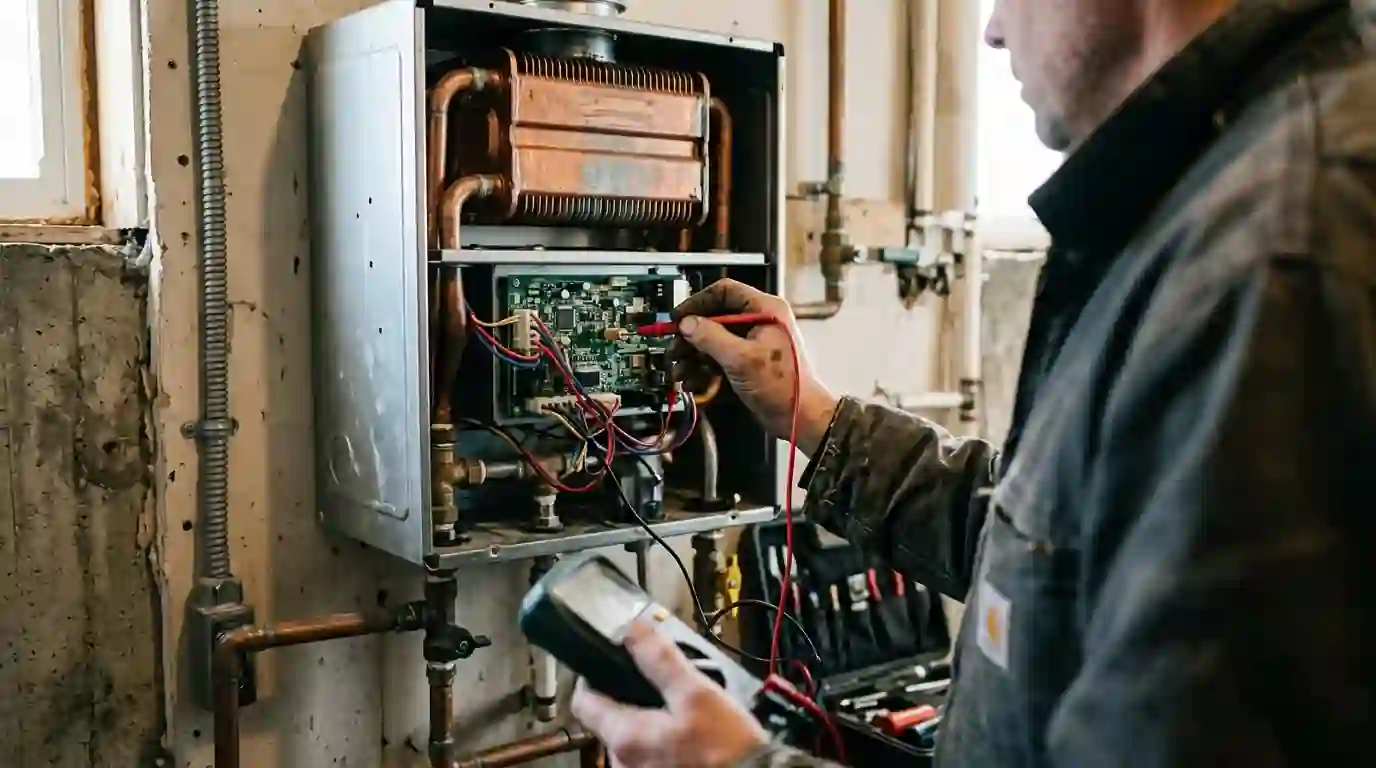
Tankless heaters log faults on the control board and show them as a code on the display. Ignition failure, flame loss, overheating, blocked exhaust and low flow each have their own number. The code points to a system, not always a single part. An ignition failure, for instance, might be a bad igniter, a dirty flame rod, low gas pressure or a frozen condensate line.
So the code is a starting point. The plumber pulls the fault history, checks gas pressure at the inlet while the unit fires at full input, and tests sensors with a meter. Most manufacturers also provide diagnostic modes that show flow rate, inlet and outlet temperature, and fan speed live, which narrows things quickly.
Scale, the main reason tankless units fail early here
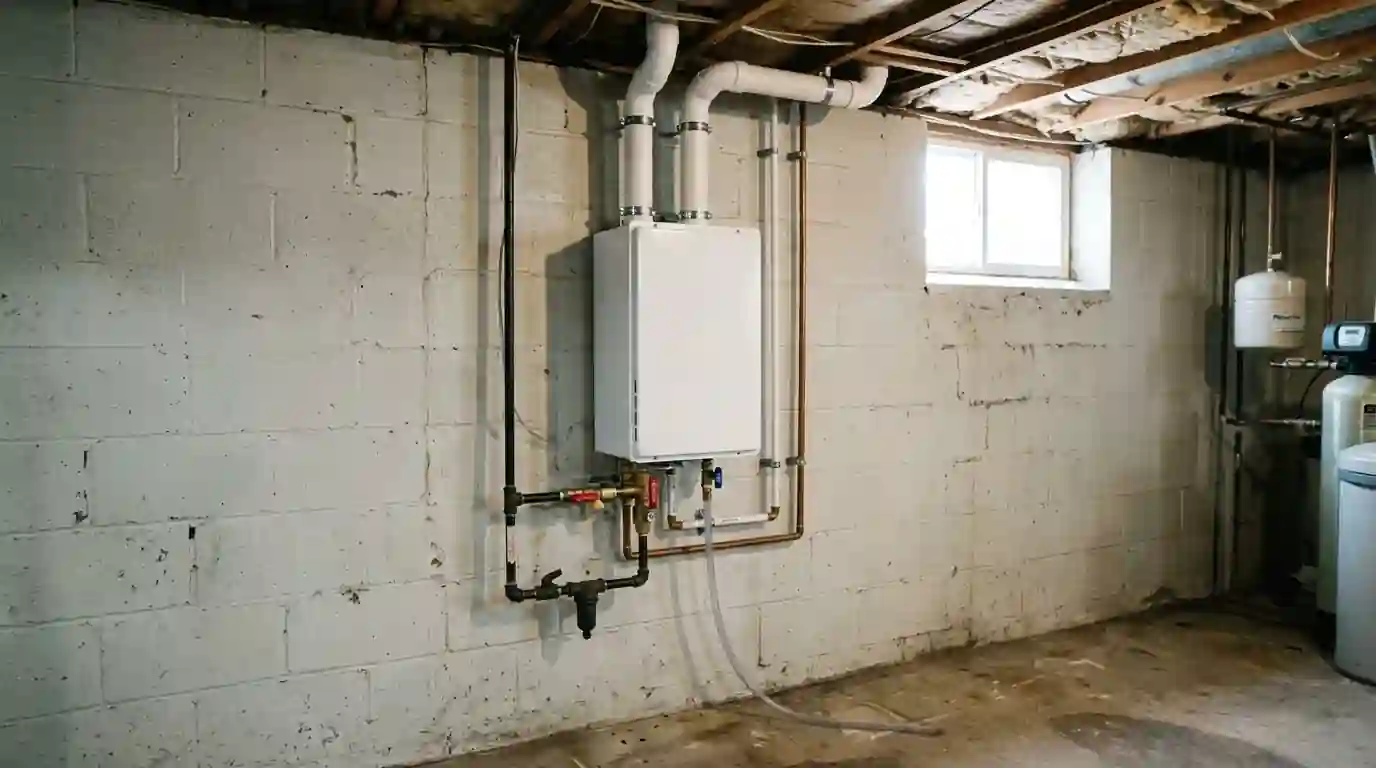
Water passes through narrow passages in the heat exchanger at high temperature. Minerals cling to those walls and build a layer that insulates the water from the flame. The unit compensates by firing harder, the exchanger overheats, and you get overheat codes, temperature swings, or a cracked exchanger in time.
Descaling means isolating the unit with its service valves, connecting a small pump and bucket, and circulating a mild acid solution through the exchanger for a set time. On hard well water this is a yearly job, and on softened city water it can stretch longer. The inlet screen filter gets cleaned at the same time, since a clogged screen causes low-flow faults.
Winter faults: frozen condensate lines and blocked vents
Condensing tankless units produce acidic water that drains through a small line to a floor drain or pump. If that line runs along a cold rim joist or through an unheated space, it can freeze in a cold snap. The trap backs up, the unit senses it, and it shuts down with a drain or exhaust fault.
Snow drifts and ice can also block the side-wall intake and exhaust terminations. A clogged intake starves the burner of air, and the unit locks out to protect itself. When PlumbTek gets a no-heat call during a January cold snap, the outside terminations and condensate route are two of the first places checked.
Tankless symptoms and what they usually mean
These are the problems we see most on tankless units across the metro.
- Cold water sandwich in the showerA brief burst of cold between hot. Some is normal with stop-and-start use, but a long gap often means a slow igniter or a minimum flow problem.
- Unit won't fire at a low flowTankless heaters need a minimum flow to start. A clogged inlet filter or aerators can keep a single sink from triggering ignition.
- Temperature swings during useScale on the heat exchanger or a failing outlet thermistor makes the burner hunt, swinging water hot and cool.
- Repeated ignition or flame loss codesLook at the flame rod, igniter, gas pressure and venting. A sooty or cracked flame rod is a frequent cause.
- Water dripping from the cabinetA leaking fitting, failed pressure relief valve or cracked heat exchanger. Turn off the gas and water until it's checked.
- Shutdown during cold snapsFrozen condensate line or a snow-blocked vent termination. Both can be cleared, and both can be prevented with better routing.
How we fix a tankless heater that won't behave
Note the code and call
Write down the error code on the display and call (612) 254-6294. The code helps us bring parts that fit your model on the first visit.
Check gas, power and venting
We verify gas pressure under full fire, confirm power at the board, and inspect intake and exhaust terminations outside.
Run diagnostic mode
Live readings of flow, inlet and outlet temperatures and fan speed show whether sensors, flow parts or the exchanger are at fault.
Repair or descale
Failed parts are replaced, and if scale is present the heat exchanger is flushed through the isolation valves with a descaling solution.
Retest at multiple taps
We run one fixture, then several, to confirm stable temperature at both low and high flow before leaving.
Tankless repair costs in Minneapolis and the suburbs, 2026
Costs depend heavily on the part and the brand. Your price depends on what the plumber finds on site, and it is explained up front.
| Job | Typical range | What moves the price |
|---|---|---|
| Descaling flush and inlet filter cleaning | $213 to $347 | Scale severity and whether isolation valves are installed |
| Flame rod or igniter replacement | $264 to $438 | Part availability for your model and board access |
| Flow sensor or thermistor replacement | $293 to $517 | Sensor location and model-specific parts |
| Control board or fan motor replacement | $586 to $1,137 | Part cost, brand, and whether the maker still covers the part |
What changes the number
- Units without isolation valves need them installed before a descaling flush can be done properly.
- Some brands have limited parts stock in the Twin Cities, which can stretch repairs over two visits.
- Heat exchanger replacement is expensive and sometimes makes replacing the unit more sensible.
- Condensate pump or line rerouting adds cost when freezing is the root cause.
- After-hours visits during extreme cold may cost more than daytime calls.
Ranges reflect typical Twin Cities jobs in 2026. Your price is explained before work starts. Compare other jobs in the PlumbTek price guide.
Before you call: quick tankless checks
These steps sometimes clear a fault and always help the diagnosis.
- Write down the exact error code shown on the display.
- Turn power to the unit off for one minute and back on to clear a lockout.
- Check that the gas valve to the unit is fully open.
- Look outside at the vent terminations for snow, ice or nests.
- Check the condensate line for kinks or ice where it runs along cold walls.
- Try a hot tap at full flow to rule out a minimum flow problem.
- Shut gas and water to the unit if you see water leaking from the cabinet.
Why Twin Cities tankless units need more attention than the brochure says
Brochures often assume moderate water hardness and mild inlet temperatures. Homes on private wells in Wright and Sherburne counties often have hard, iron-bearing water, and units there can scale up in a single year without a softener or scale filter. Even softened Minneapolis homes still benefit from a periodic flush, because softening reduces scale but doesn't remove every mineral.
Cold is the other factor. Units mounted in garages, on exterior walls, or near drafty rim joists face freeze risk in deep cold. Most have freeze protection heaters inside, but those need power. A long outage in January can leave water trapped in the exchanger, so PlumbTek shows you how to drain the unit before a planned shutdown.