Water heater repair in Minneapolis, the short answer
Water heater repair in Minneapolis means finding and replacing the one failed part on a gas or electric tank, such as a thermocouple, gas control valve, heating element or dip tube, so the tank you already own keeps working. You need it when hot water runs out early, smells off or stops altogether, and the tank shell itself is not leaking.
Why a gas water heater loses its pilot in a cold basement
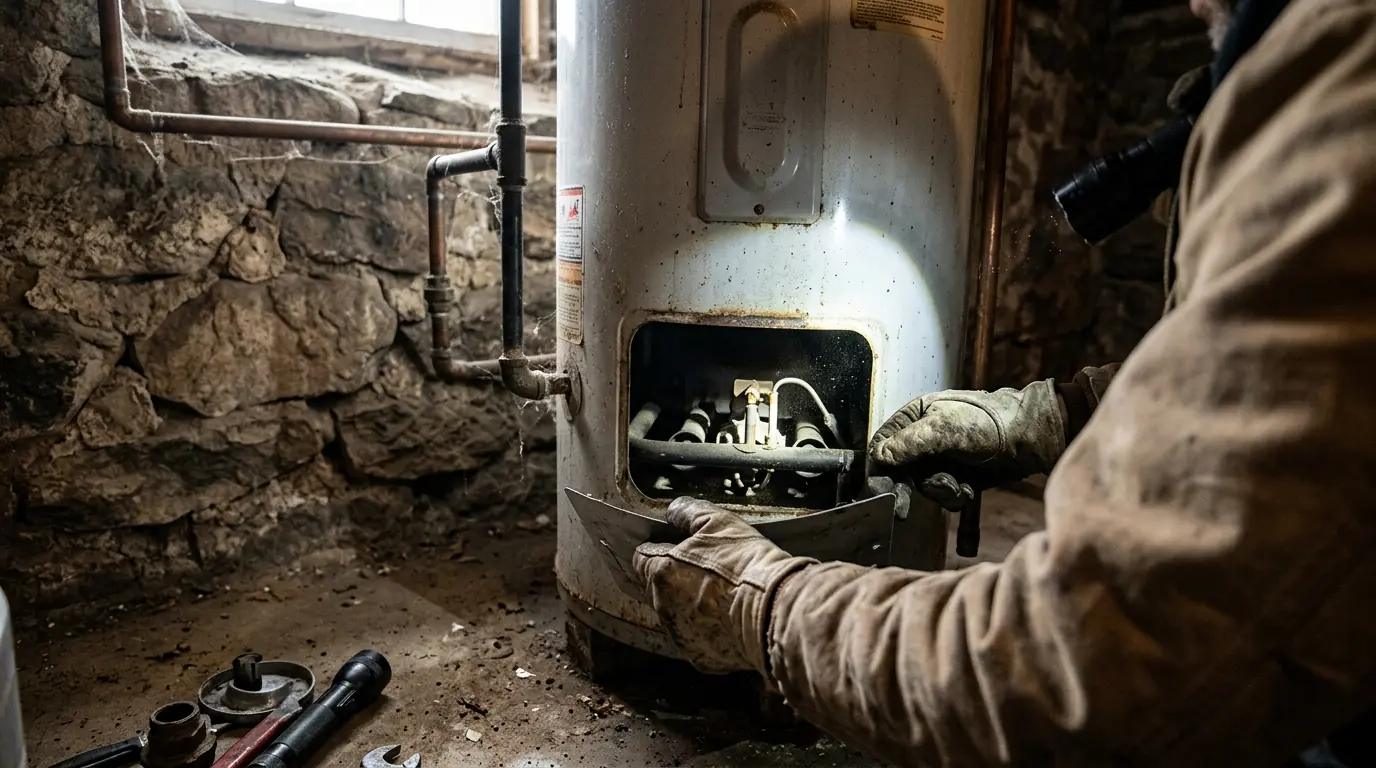
On a standing-pilot tank, a thermocouple sits in the pilot flame and tells the gas control valve it's safe to keep gas flowing. When that tip wears out or gets sooted, the valve shuts the gas and the pilot dies. Newer tanks with flammable vapor protection add a sealed combustion chamber and a flame arrestor screen underneath, and lint or dust on that screen can starve the burner of air.
Drafts matter too. An unfinished basement with a leaky window can push cold air across the burner in January. We check thermocouple output with a meter, look at flame color, clean the arrestor screen, and confirm the draft hood is pulling exhaust up the vent.
What fails on an electric tank, and how each part gets tested
Electric water heaters have two elements and two thermostats, plus a high-limit switch above the upper thermostat. If you get a little hot water that runs out fast, the lower element has often burned out. If you get none, the upper element or a tripped high-limit is the usual cause. Hard water speeds this up, because scale packs around the lower element and it overheats.
The plumber shuts off the breaker, confirms the circuit is dead, then tests each element for resistance and each thermostat for continuity. A failed element is replaced with one of matching wattage, and the tank gets a partial flush so the new element isn't sitting in sediment. You'll have hot water again after one recovery cycle.
Lukewarm water, odd smells and rumbling: the parts behind them
A tank that heats fine but delivers lukewarm water may have a broken dip tube. That plastic tube carries incoming cold water to the bottom of the tank. When it cracks, cold water mixes in at the top and goes straight to your faucets. Flecks of white plastic in faucet aerators are a common clue. Rumbling or popping means sediment on the tank floor is trapping water and boiling it.
A rotten egg smell, mostly on well water, comes from bacteria reacting with the magnesium anode rod. An aluminum zinc or powered anode usually clears it. If the T&P relief valve drips, we check house pressure and the expansion tank first, because a valve that opens is often just doing its job.
Clues that point to a fixable water heater fault
These symptoms usually trace back to one part, not a failed tank.
- Pilot lights, then goes outUsually a worn thermocouple or a clogged flame arrestor screen. The gas control valve is shutting off gas because it cannot confirm a steady flame.
- Hot water runs out fastOn electric tanks this is often a burned lower element. On gas tanks it can point to a broken dip tube or a thick sediment layer.
- Lukewarm water at every tapA cracked dip tube or a thermostat set too low. White plastic bits caught in your aerators make the dip tube the likely suspect.
- Relief valve dripping onto the floorHigh house pressure, a waterlogged expansion tank or a worn T&P valve. All three get checked before anything is replaced.
- Sulfur smell from hot taps onlyThe anode rod is reacting with your water. Common on private wells in Sherburne and Wright counties, and usually fixed with a different anode.
How a water heater repair call goes from first ring to test fire
Phone answered any hour
Call (612) 254-6294 and describe what you're seeing. Leaks and winter no-heat calls get moved up the list, and we'll walk you through shutting the tank down safely.
Safety and vent check
The plumber checks for gas odor, confirms the vent is drafting, and looks at the tank base and fittings for rust or seepage before touching any controls.
Part-level diagnosis
Thermocouple output, element resistance, thermostat continuity and dip tube condition are tested with meters, not guessed. You see what failed and why.
Price explained first
You hear the repair price, along with an honest read on the tank's age and condition, before any part is ordered or installed.
Repair and full cycle test
The part goes in, the burner or elements run through a full heating cycle, and the T&P valve and temperature setting are checked before we pack up.
What water heater repairs cost in the Twin Cities in 2026
These are typical ranges for common repairs. Your actual price depends on the tank, the part and access, and it's explained before work starts.
| Job | Typical range | What moves the price |
|---|---|---|
| Thermocouple or pilot assembly | $187 to $312 | Standing pilot versus sealed burner design, and part availability |
| Gas control valve replacement | $463 to $787 | Valve make, whether the tank must be drained, and gas fitting work |
| Electric element and thermostat | $219 to $397 | One or both elements, scale buildup, and thermostat swaps |
| Dip tube or anode rod swap | $241 to $418 | Ceiling clearance above the tank and seized hex fittings |
What changes the number
- Tank age matters, because a twelve-year-old tank with a failed gas valve may not be worth the repair.
- Seized fittings on older tanks add time, especially anode rods that haven't been touched since the day of install.
- Tight closets and low basement ceilings make anode and dip tube work slower.
- Code issues found during the repair, like a missing expansion tank or poor venting, are priced separately.
Ranges reflect typical Twin Cities jobs in 2026. Your price is explained before work starts. Compare other jobs in the PlumbTek price guide.
Quick checks before you call about no hot water
A few of these take a minute and can save you a service visit.
- Look through the sight window on a gas tank to see whether a pilot flame is present.
- Make sure the gas control knob is set to on, not pilot or vacation.
- On an electric tank, check the breaker and reset it one time only.
- If the tank is hot but taps run cold, suspect the dip tube or a stuck mixing valve.
- Check the floor around the base for water and the T&P discharge pipe for drips.
- If you smell gas, leave the house and call the gas utility before anything else.
Minneapolis basements and the water heaters that live in them
In older Minneapolis and Saint Paul homes the water heater often shares a masonry chimney with the furnace. When the old furnace gets replaced by a high-efficiency unit vented out the side wall, the water heater is left alone in an oversized flue, and it can backdraft. Pilot trouble in those houses often starts right there, so PlumbTek checks draft on every gas tank.
Winter adds its own load. Water coming in from the city mains is very cold in January, so the burner runs longer to heat each gallon. A marginal tank that kept up in September can fall behind by February, and that's when a weak element or tired gas valve finally shows itself.