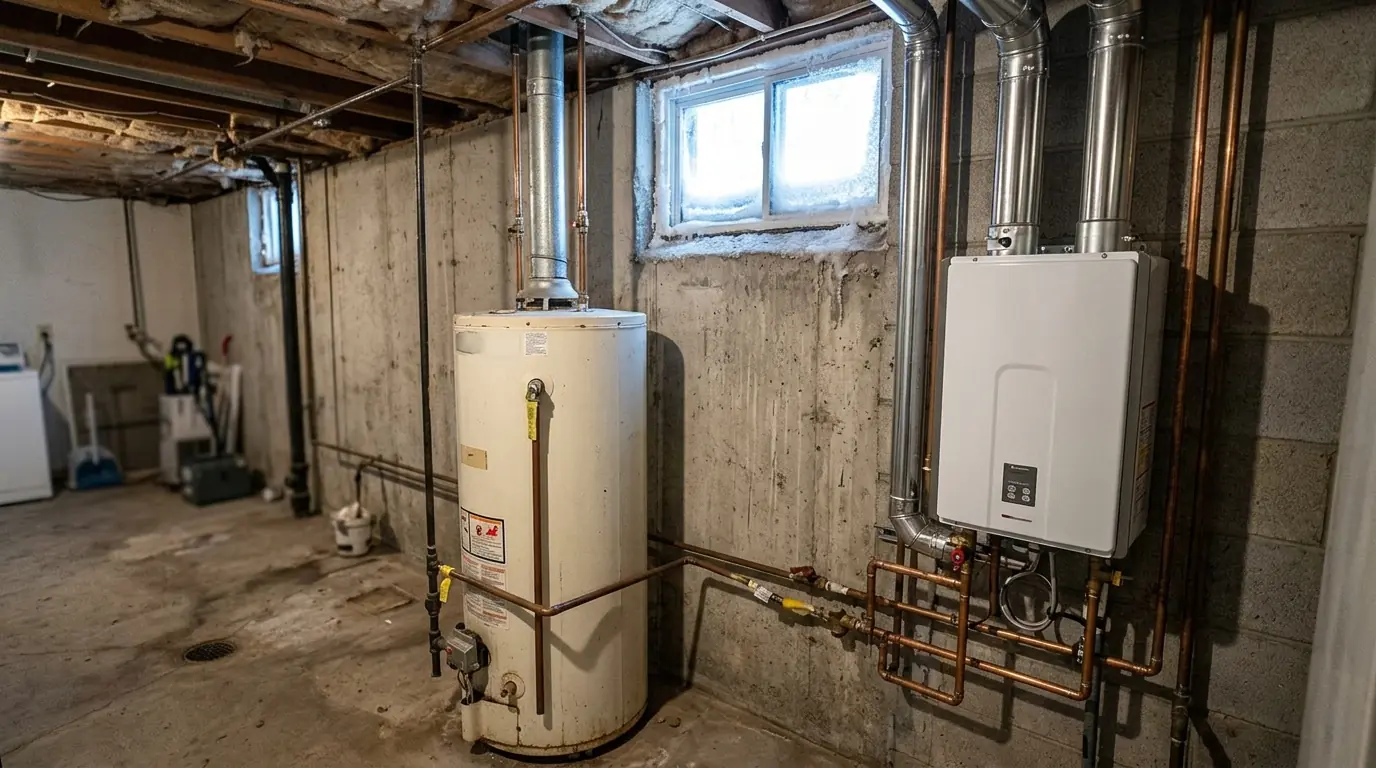
The short version
- Cold winter inlet water lowers how many gallons per minute a tankless unit can deliver.
- Tank heaters cost less up front and are simpler to replace in most Twin Cities basements.
- Tankless units need adequate gas supply, new venting and softened water to perform well.
- Size either type for your coldest month, not for summer.
Why does Minnesota water temperature matter so much?
A water heater's job is to raise water from whatever temperature it enters at to the setting you want, usually around 120 degrees. In the Twin Cities, water coming in from the street or a well is noticeably colder in January and February than in late summer. That means every gallon needs more heat before it reaches your faucet.
For a tank heater, colder water mainly slows recovery: it takes longer to reheat the tank after a few showers. For a tankless heater, colder water directly limits flow. A unit that can run two showers at once in August may only manage one comfortably in February. This is the single most overlooked factor when people compare the two types here.
How does a tank water heater hold up in a Twin Cities home?
A conventional tank stores 40 to 75 gallons of hot water and keeps it ready. Its strengths are simplicity and cost. Most Minneapolis and suburban basements already have the gas line, the flue and the floor space it needs, so a like-for-like swap is usually a one-day job. It also handles several taps running at once without fuss, as long as the stored hot water lasts.
The downsides are standby heat loss, since the tank keeps reheating water nobody is using, and limited supply when a big family showers back to back. Sediment from hard water settles at the bottom and can make the burner rumble. With a yearly flush, a tank heater in the Twin Cities generally lasts somewhere around a decade, sometimes more with softened water.
- Lower installed cost and simpler permitting
- Handles simultaneous use until the tank runs down
- Works with existing venting in most older homes
- Loses some heat to standby, especially in cold basements
When does a tankless heater make sense here?
A tankless unit heats water only as it flows, so it never runs out as long as demand stays within its capacity. It's compact, mounts on a wall, and frees up floor space in tight utility rooms. In larger homes with long, steady demand, such as a bath filling while someone showers, a properly sized unit delivers endless hot water rather than a fixed supply.
The catch is installation. A gas tankless heater needs a much larger gas supply than a tank, often requiring a bigger line from the meter. It needs its own stainless or PVC venting, and it needs softened water, because scale builds quickly on its heat exchanger. In older Minneapolis homes with long gas runs, those upgrades can double the job's cost.
How should you size a heater for a Minnesota winter?
Start with the coldest month. For a tank, look at first-hour rating, which tells you how much hot water the heater can deliver in an hour starting from a full tank. A family of four with two bathrooms usually lands in the 50 gallon range, but a big soaking tub or teenagers taking long showers can push that higher.
For tankless, count the fixtures you expect to run at the same time and add up their flow rates. Then check the unit's rated flow at the temperature rise you need in winter, not the headline number on the box. A good installer runs that math with you and explains why a slightly larger unit or two units might be needed.
- List the fixtures you run at the same time during the morning rush.
- Estimate each one's flow, from low-flow showers to a bathtub spout.
- Find the winter temperature rise from inlet water to 120 degrees.
- Match a tank's first-hour rating or a tankless unit's winter flow to that demand.
- Confirm the gas line and venting can support the choice before buying.
What do tank and tankless heaters cost in 2026?
In the Twin Cities in 2026, replacing a standard 40 or 50 gallon gas tank usually runs about $1,687 to $2,846 installed, including the permit and hauling the old tank away. Larger or high-efficiency power-vent tanks cost more. A gas tankless installation typically lands between $3,486 and $6,213, with the high end reflecting new gas line, venting and a softener connection.
Operating costs favor tankless modestly, since it avoids standby loss, but the payback period depends on your household's usage and gas rates. The actual price for either option depends on the job and should be explained before work starts. When PlumbTek prices a replacement, both options are laid out with the specific upgrades each one would require in your house.
Which questions settle the choice for your home?
Ask how long you plan to stay, how many people use hot water at peak times, whether your water is softened, and how far the heater sits from the gas meter. If you're staying a few years, have soft city water and a modest household, a new tank is usually the sensible call. If you're staying long, have high demand and room in the budget for upgrades, tankless is worth pricing.
Either way, the installation itself matters as much as the brand. Correct venting, a working relief valve, an expansion tank where needed, and proper gas sizing all affect safety and performance. If you'd like to talk through both options for your house, call PlumbTek at (612) 254-6294 and describe your current setup.
Reader questions
Does a tankless water heater work with Minnesota well water?
It can, but only with water treatment in place. Well water in Sherburne, Wright and other outlying counties is often hard and iron-heavy, which coats a tankless heat exchanger quickly and reduces output. A softener, often with an iron filter ahead of it, plus regular descaling, keeps a tankless unit running properly on a private well.
Can a tankless heater replace a tank in an old Minneapolis house?
Usually yes, but expect extra work. Older Minneapolis homes often have small gas lines and masonry chimneys that a tankless unit can't use. Replacing a tank with tankless typically means a larger gas line from the meter, new sidewall or roof venting, and sometimes electrical work for the unit's controls. Those upgrades drive most of the cost difference.
How long does a tankless water heater last compared with a tank?
With softened water and periodic descaling, a tankless unit commonly outlasts a tank heater, partly because its parts can be serviced and replaced individually. Neglected units on hard water can fail much sooner. A tank heater's life depends heavily on water quality and flushing, and the anode rod plays a large role in how long the tank resists corrosion.