The short version
- Buyers in Minneapolis and Saint Paul inherit the sewer lateral from house to city main.
- General home inspections rarely include a camera run down the lateral.
- Roots, offsets, sags and cracked pipe all show clearly on a recorded video.
- The findings give you room to negotiate repairs or a credit before closing.
What part of the sewer does a buyer actually inherit?
In Minneapolis, Saint Paul and most surrounding cities, the property owner is responsible for the sewer lateral, the pipe that runs from the house's foundation out to the city main in the street or alley. That includes any section under the boulevard and sometimes the connection itself. If it breaks, the repair bill lands on whoever owns the house that day.
In homes built from the 1880s through the 1940s, that lateral is commonly clay tile laid in short sections with joints every couple of feet. Some were replaced with cast iron or plastic at some point, and many weren't. You won't know which you have by looking at the basement, which is exactly why a camera inspection matters.
What does a sewer camera inspection show?
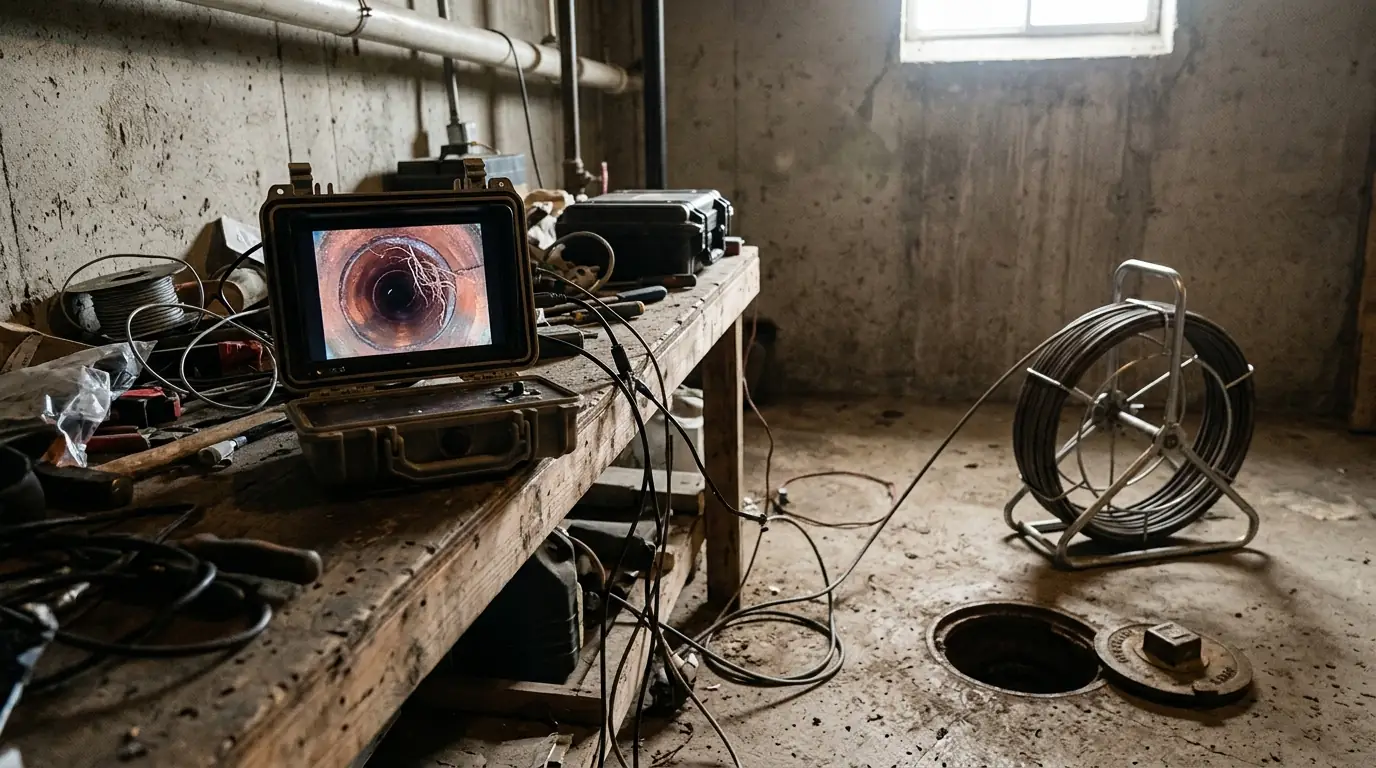
A plumber feeds a flexible cable with a waterproof camera through a cleanout, usually in the basement near where the line leaves the house. The camera travels the full length of the lateral while a monitor shows the inside of the pipe in real time. A locator tracks the camera head from above, so problems can be marked on the yard and measured for depth.
The recording shows the pipe material and any transitions, roots growing through joints, sections that have shifted out of line, bellies where water pools, cracks, and any collapsed or crushed areas. It also shows how far each defect sits from the foundation, which drives the cost of any repair. A good inspector narrates what each finding means as it appears.
- Root intrusion at clay tile joints
- Offset or separated joints
- Bellies or sags that collect water and debris
- Cracks, fractures or crushed sections
- Changes in pipe material and the condition at each transition
Why don't general home inspections cover this?
A standard home inspection focuses on what's visible and accessible inside the house. The inspector may run water and check that drains empty, but a lateral that's partly blocked by roots or cracked underneath can still drain fine during a short test with an empty house. The trouble shows up later, under a full family's daily use or in a heavy storm.
Most home inspectors don't carry sewer cameras, and those that do may not run the entire lateral to the main. Hiring a plumber for the camera inspection gives you a separate, focused look at the one system most likely to produce a five-figure surprise in an older house. In Minneapolis and Saint Paul, the Truth in Sale of Housing evaluation also doesn't scope the lateral.
When should you schedule it during a purchase?
Book the camera inspection inside your inspection contingency period, the same window you use for the general home inspection. That timing keeps your options open if the results are bad. You'll need the seller's permission and access to a cleanout, so let your agent know early that a sewer scope is part of your plan.
If there's no accessible cleanout, the plumber may run the camera through a toilet flange or a roof vent, which takes more time and sometimes costs more. Ask the plumber to record the whole run and give you the video file along with a written summary. That record helps with negotiations and becomes a useful baseline once you own the home.
- Add a sewer scope to your inspection plan when you make the offer.
- Ask the listing agent where the cleanout is and confirm access.
- Book a plumber inside the inspection contingency window.
- Get the recorded video and a written summary of findings.
- Use any defects to negotiate repairs, a credit or a price change.
What do typical findings cost to fix?
A sewer camera inspection in the Twin Cities typically runs about $217 to $438 in 2026. If roots are the main issue and the pipe is otherwise intact, a root cutting and cleaning usually costs $237 to $612 and may need repeating every year or two. A spot repair of a single cracked or offset section often runs $2,387 to $5,946, depending on depth and location.
A trenchless liner or a full lateral replacement costs considerably more, especially for long runs, deep lines or sections under trees, driveways or the street. Every lateral is different, so the real figure comes from the camera footage and is explained before any digging or lining. When PlumbTek runs a pre-purchase camera inspection, each option is laid out with its price so you can bring clear numbers to the negotiation.
How do you use the results in a negotiation?
If the lateral is in good shape, you've spent a few hundred dollars for real confidence in one of the most expensive systems in an older house. If it shows roots only, you might ask for a cleaning before closing. If it shows cracks, sags or collapse, a written repair price lets you request a repair, a credit at closing or a price reduction.
Sellers and their agents respond best to specifics: the video, the distance to each defect and a repair price from a plumber. To set up a pre-purchase sewer camera inspection, call PlumbTek at (612) 254-6294 with the address and your inspection deadline.
Reader questions
How long does a pre-purchase sewer camera inspection take?
Most pre-purchase sewer camera inspections take about an hour, sometimes a bit longer if the cleanout is hard to open or the line needs clearing before the camera can pass. Plan for the plumber to explain findings on site and send the video afterward. Allow extra time if the camera has to go in through a toilet or roof vent.
Should I scope the sewer on a newer house too?
Newer homes with plastic laterals have fewer problems, but a sewer scope can still catch construction debris, a belly from settling soil, or damage from a nearby excavation. For houses built in the last couple of decades the risk is lower, so it's more of a judgment call. For anything older, especially pre-1950, it's well worth doing.
Can a seller refuse a sewer camera inspection on a Minneapolis home?
A seller can decline, but it's uncommon, and a refusal tells you something on its own. Most Minneapolis sellers allow it during the inspection period as long as the plumber leaves the cleanout and basement as found. If access is denied, you can still choose to walk away or factor the unknown lateral into your offer.