The short version
- Nearly every Minneapolis basement floor drain connects to the sanitary sewer, not to storm drains.
- Backups during storms usually come from a partly blocked lateral, a surcharged city main, or both at once.
- You own the sewer lateral from the house to the main, so its repair is on you.
- A camera inspection tells you which problem you have before you pay for a fix.
Where does a basement floor drain actually go?
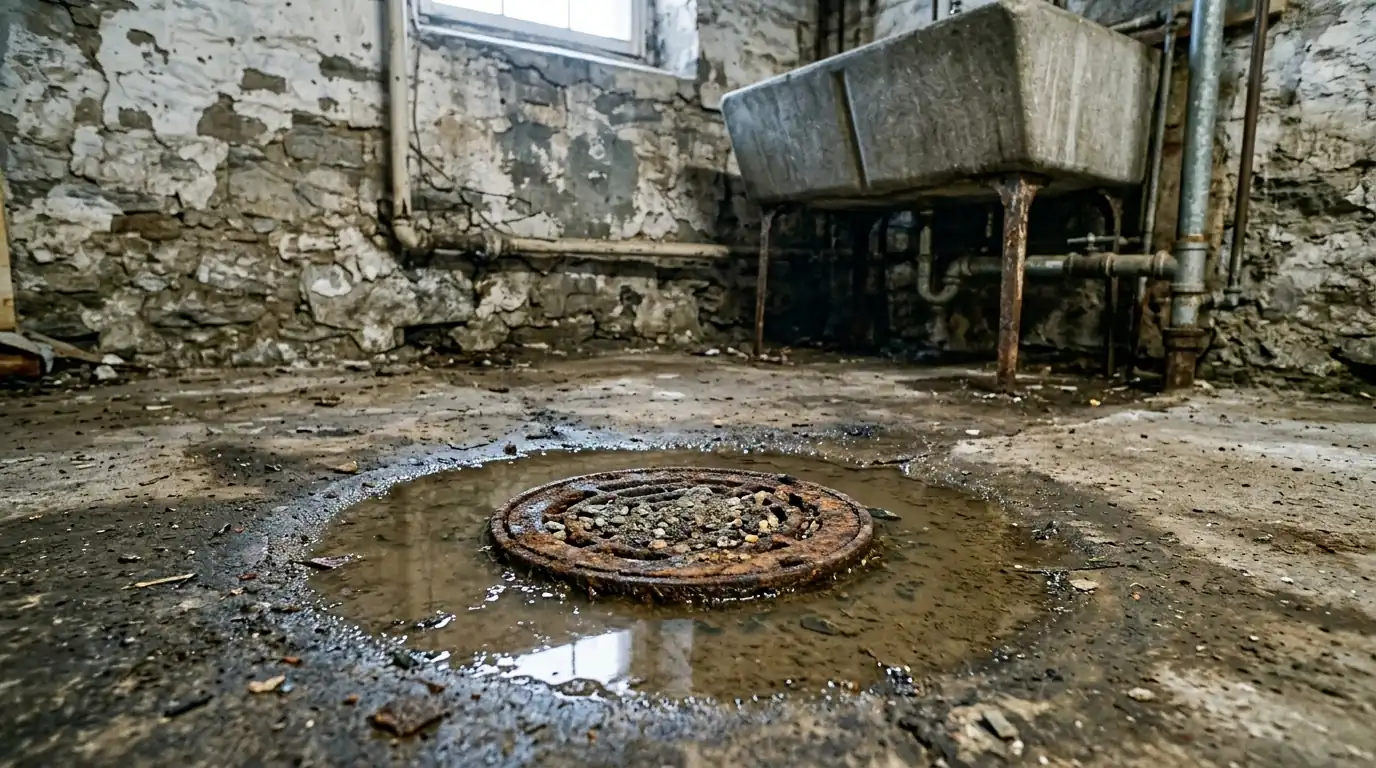
In most Minneapolis and Saint Paul houses, the round grate in the basement floor ties into the same sanitary sewer pipe that carries toilet and sink waste. It sits at the lowest point in the plumbing, which makes it the first place water shows up when the pipe downstream can't keep up. That's by design: better a puddle by the drain than a toilet overflowing upstairs.
Under the grate there's usually a trap that holds a plug of water to keep sewer gas out. From there the drain joins the building drain, which leaves through the foundation wall and becomes your sewer lateral. In older homes that lateral is typically clay tile or cast iron, and it runs under the yard to the city main in the street or alley.
What pushes water up through the drain during a storm?
There are two basic causes, and many backups involve a bit of both. The first is a restriction in your own lateral. Roots, grease, a sagging section that holds water, or an offset joint narrow the pipe. On a dry day the flow squeezes through. During a storm, when the city main runs fuller and drains more slowly, the bottleneck tips into a backup.
The second cause is surcharge. When heavy rain overwhelms the sanitary system, often because groundwater and stormwater leak in through cracked pipes and old connections, the city main fills beyond its normal level. Water then has nowhere to go but backward, up every lateral on the block, and out the lowest opening it can find. In many homes, that is the floor drain.
- Roots entering clay tile joints, common under mature boulevard trees
- Grease and soap scum that harden into a ring inside the pipe
- A belly or sag in the lateral that collects sediment
- Foundation drain tile or downspouts improperly tied into the sanitary line
- A city main running full during an intense downpour
How can you tell whether the problem is yours or the city's?
Watch the timing and the pattern. If your drain only backs up during big storms and neighbors on the same block report the same thing, a surcharged main is likely playing a role. If you also notice slow drains, gurgling toilets or a backup after running the washer on a clear day, the restriction is almost certainly in your own lateral.
A sewer camera inspection removes the guessing. A plumber feeds a camera through a cleanout and records the lateral all the way to the main, noting roots, cracks, sags and the distance from the foundation to each one. If the line is clean and intact, the conversation turns to protection devices. If it isn't, cleaning or repair comes first.
What fixes actually stop floor drain backups?
Clearing the lateral is the starting point when roots or grease are involved. A cable machine cuts through roots and opens the line, while hydro jetting scours the pipe walls and flushes debris out. Neither repairs a broken pipe, so if the camera shows cracked or collapsed sections, a spot repair, a trenchless liner or a replacement is the lasting answer.
A backwater valve is the main tool against surcharge. It's a one-way flap installed in the building drain that lets wastewater flow out but closes when water tries to come back in. It needs a cleanout for access and occasional checks so debris doesn't hold the flap open. Some people add a floor drain plug with a float, which is cheaper but protects only that one opening.
- Have the lateral cleaned if roots or grease show on the camera.
- Repair or line any cracked, offset or sagging sections.
- Disconnect downspouts or drain tile that feed the sanitary line.
- Install a backwater valve with an access cover in the building drain.
- Check the valve flap each spring and after any major backup.
What does stopping a floor drain backup cost in the Twin Cities?
Prices vary with access, depth and what the camera shows. As a rough 2026 guide in the Twin Cities, a lateral cleaning with a cable or jetter runs about $237 to $612. A sewer camera inspection with a recorded video is typically $217 to $438. Installing a backwater valve in an existing building drain usually falls between $1,487 and $3,276, depending on how much concrete has to come out.
Spot repairs and trenchless liners cost more, and a full lateral replacement can run well into five figures when the line is long or deep. The actual price depends on the job, and any reputable plumber should explain it to you before work starts. PlumbTek walks through each option on site so you can weigh cost against how long the fix will last.
What should you do the moment water comes up?
Stop using water in the house: no flushing, no laundry, no dishwasher. Every gallon you send down has to go through the same blocked pipe and will come out at the floor drain. Move valuables, rugs and boxes off the floor, and keep kids and pets away from the water, since it is wastewater and carries bacteria.
If the water keeps rising after the rain stops, the lateral is probably blocked and needs clearing. Call a plumber who answers around the clock; at PlumbTek the line is (612) 254-6294. Once the water recedes, clean and disinfect the floor, dry the area with fans, and plan a camera inspection so the next storm doesn't repeat it.
Reader questions
Can a backwater valve go on an older Minneapolis floor drain?
Yes, in most cases. The valve installs in the building drain, usually inside the basement just before the line leaves the foundation. In older Minneapolis homes with cast iron or clay piping, that may mean cutting the concrete floor and transitioning to new pipe at the valve. A cleanout or access cover is included so the flap can be checked later.
Does homeowners insurance cover a floor drain sewer backup?
Standard policies often exclude sewer backup unless you've added a specific backup endorsement. Coverage limits and terms vary widely, so read your policy or call your agent before a storm season. Keep photos of the damage and any plumber's camera findings, because an insurer may ask what caused the backup and whether the lateral was maintained.
Why does my floor drain smell like sewer between storms?
The trap under the drain has probably dried out. If the drain rarely sees water, evaporation empties the trap and lets sewer gas into the basement. Pour a gallon of water into the drain every few weeks, or add a trap primer or seal. A persistent smell after refilling can also point to a cracked pipe or vent problem.