The short version
- Homes built before about 1950 are the most likely to have lead service lines.
- Minneapolis and Saint Paul both offer address lookups for service line material.
- A simple scratch test at the meter can identify lead in a few seconds.
- Until it's replaced, run cold water before drinking and use a lead-rated filter.
What a water service line is and who owns it
The water service line is the pipe that carries water from the city main under the street into your house. It runs underground, below the frost line, and comes up through the basement floor or foundation wall to the water meter. In older Twin Cities neighborhoods, many of these lines were made of lead because it was soft, easy to bend around obstacles and lasted for decades.
Ownership is usually split. The city typically owns the portion from the main to the curb stop near the property line, and the homeowner owns the part from the curb stop into the house. A line can also be mixed, with lead on one side of the curb stop and copper on the other, which is why both sides matter when you check.
Which Twin Cities homes are most likely to have lead
Age is the biggest clue. Homes built before about 1950 are the most likely to have a lead service line, and the risk drops sharply for houses built later. In Minneapolis, that covers a lot of Longfellow, Powderhorn, Phillips, Whittier, Northeast and North Minneapolis. In Saint Paul, it includes much of Frogtown, the East Side, Payne-Phalen, Summit-University and the West End.
Some older homes already had their line replaced during a street project, a main break or a past remodel, so age alone doesn't settle it. Newer suburbs like Woodbury, Maple Grove and Lakeville are very unlikely to have lead service lines. Homes on private wells in Sherburne and Wright counties don't have a city service line at all, though the well water itself is worth testing for other reasons. When in doubt, the scratch test below takes less time than reading the city records.
How to check your own service line in a few minutes
Start with the city. Both Minneapolis and Saint Paul Regional Water Services run lead service line programs with online address lookups that show what their records say about your line. Records can be incomplete, especially for the private side, so it's worth confirming with your own eyes at the water meter.
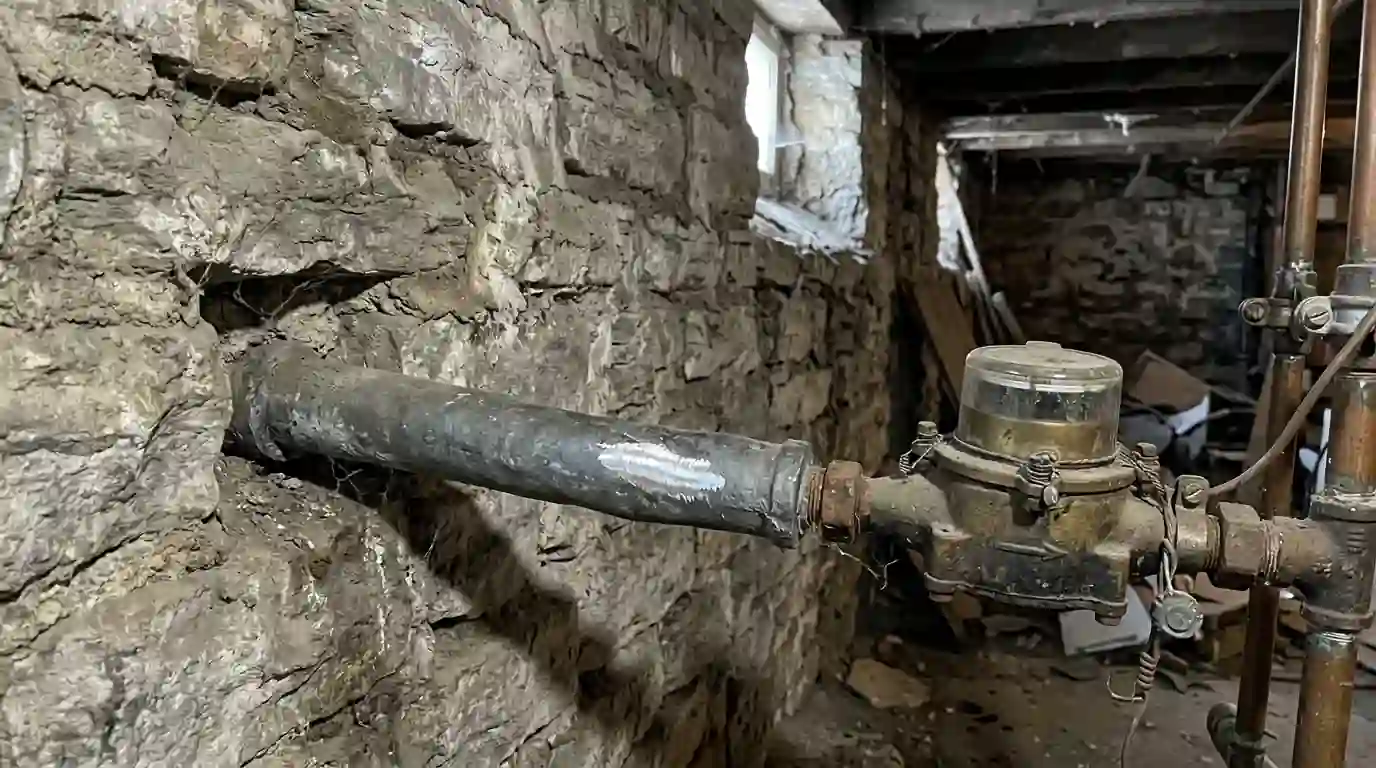
- Find where the water line comes through the basement floor or wall, just before the water meter.
- Look at the pipe between the wall or floor and the meter. Lead is dull gray, often with a bulging, rounded joint called a wiped joint.
- Gently scratch the pipe with a key or coin. Lead scratches easily and shows a shiny silver color underneath.
- If the scratch shows copper color, it's copper. If it's hard, gray and a magnet sticks, it's galvanized steel.
- Take a photo of the pipe and the scratch, and compare it with what the city lookup says.
Why galvanized pipe after a lead line matters too
Some older homes have galvanized steel pipe inside the house that was once downstream of a lead service line. Over decades, the rough inner surface of galvanized pipe can collect lead particles, which can break loose later even after the lead service line itself is replaced. That's one reason a plumber looks at the interior piping, not just the line at the meter.
Galvanized pipe also rusts from the inside, narrowing until water pressure drops at upstairs fixtures. If your house has both a lead service line and galvanized supply piping, it often makes sense to plan the service line replacement and an interior repipe together, so you deal with both sources at once. Opening walls once costs less than opening them twice.
What to do while the lead line is still in place
Lead gets into water when it sits in contact with the pipe, so the goal is to limit how long water stays in the line before you drink it. The city treats its water to reduce corrosion, which helps, but simple habits at home add another layer of protection.
- Run cold water for a few minutes, or until it feels colder, if it has sat for several hours
- Use only cold water for drinking, cooking and baby formula
- Install a filter rated for lead reduction under NSF/ANSI 53, and change cartridges on schedule
- Clean faucet aerators every few months to remove trapped particles
- Ask the water utility about lead testing for your tap water
Replacing a lead service line in Minneapolis or Saint Paul
Both Minneapolis and Saint Paul run lead service line replacement programs, and the details, including any cost sharing and scheduling, are set by each city. Start by checking the city program for your address. Some homeowners get their line replaced through the program, while others choose to replace the private side sooner with their own plumber.
Replacement usually involves excavating at the curb stop and at the house, or pulling a new copper line through using a trenchless method where soil conditions allow. A permit and inspection are part of the job, and PlumbTek pulls the permits the job needs. Water is typically off for part of a day. When the work is done, the lines get flushed and the aerators cleaned to clear any loose particles.
Reader questions
Can a lead service line be identified without digging up the yard?
Usually, yes. The city address lookup gives a starting point, and a scratch test on the pipe just before the water meter shows the material entering the house. That confirms the private side at the foundation. The buried portion out to the curb stop can only be confirmed by excavation, but the visible section is a good indicator.
Does a water softener or filter remove lead from a lead service line?
A water softener isn't designed to remove lead. A point-of-use filter rated for lead reduction, such as a faucet-mounted or under-sink unit, can lower lead levels at that tap. Filters only protect the water they treat, so they're a stopgap until the lead service line is replaced, not a substitute for replacement.
Will replacing a lead service line disturb my basement floor or lawn?
Some disturbance is normal. The crew digs near the curb stop and where the line enters the house, which may mean a small opening in the basement floor or foundation. Trenchless methods can avoid a long trench across the lawn. Sod, concrete and landscaping are restored afterward as part of the plan discussed before work starts.