The short version
- Minneapolis and Saint Paul treat and soften city water before it reaches your tap.
- Many suburbs and almost all private wells deliver hard, often iron-bearing water.
- A simple hardness and iron test should come before buying any equipment.
- Heavy iron usually needs a filter ahead of the softener, not a bigger softener.
Is Twin Cities water actually hard?
It depends on the source. Minneapolis and Saint Paul draw from the Mississippi River and treat their water, including a softening step, before sending it out. Many homes in those two cities run without a softener and see little scale. That said, some owners still add one for a bit more softness, especially when a tankless heater is involved.
Many suburbs pump from groundwater wells, and groundwater in this region tends to be hard. Private wells in Sherburne and Wright counties, around Big Lake and Elk River, and in parts of Minnetonka and other western suburbs are often hard and also carry dissolved iron. In those homes, a softener is close to standard equipment.
What signs point to hard water in your house?
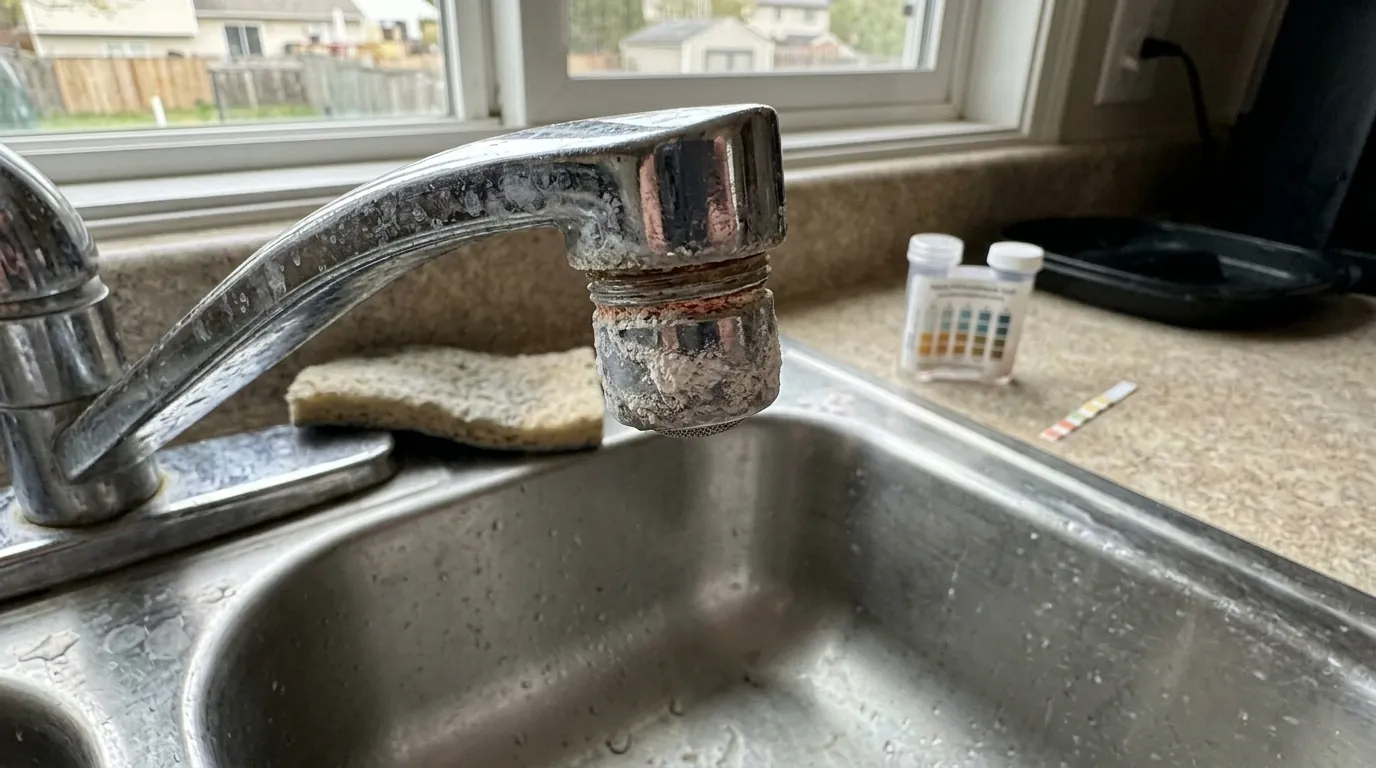
Hard water leaves minerals behind wherever it evaporates or heats up. You'll see it before you test for it. White crust builds on faucet aerators and showerheads, glass shower doors turn cloudy, and dishes come out of the dishwasher spotted. Inside the water heater, the same minerals settle as sediment and make the burner pop and rumble.
Iron shows up differently, as orange or rust-brown stains in toilets, sinks and laundry. Water that looks clear from the tap but stains once it sits is a classic sign of dissolved iron. A sulfur or rotten egg smell from hot water is another clue on well systems, often tied to the water heater's anode rod reacting with the water.
- Crusty white buildup on aerators and showerheads
- Spotty glassware and a film on shower doors
- Soap that won't lather well and stiff laundry
- A rumbling or popping water heater
- Orange or brown staining in toilets and sinks
How do you test your water before buying anything?
A hardness test strip from a hardware store gives a quick reading in grains per gallon. For homes on city water, your utility's annual water quality report also lists hardness. For private wells, a lab test is worth the small cost, because it shows hardness, iron, manganese and whether bacteria or nitrates are present.
Test the raw water before any treatment equipment, ideally at an outdoor faucet or a tap on the line before the softener. If you already have a softener, a second test after it shows whether it's actually working. Bring both numbers to any conversation about equipment so the system gets sized to your water rather than to a sales pitch.
- Find your city's water quality report or collect a raw well sample.
- Test hardness and iron at a tap before any treatment equipment.
- If you already have a softener, test again after it.
- Write down household size and daily water use.
- Share the numbers with your plumber to size the right system.
What does a softener do, and what can't it do?
A water softener swaps hardness minerals, calcium and magnesium, for sodium or potassium as water passes through a resin bed. When the resin is full, the unit regenerates by flushing it with brine from the salt tank and sending the rinse to a drain. A properly set softener protects the water heater, fixtures and appliances from scale.
Softeners can handle small amounts of iron, but heavy iron fouls the resin and shortens its life. In those cases, an iron filter goes in first and the softener follows. A softener also doesn't remove lead, bacteria or most chemicals, so a home with a lead service line or a well with contamination needs a different treatment plan entirely.
What does a softener cost to install and run in 2026?
In the Twin Cities in 2026, installing a new softener usually runs about $1,385 to $2,967, depending on the unit's size and features, and whether a loop, bypass valve and drain connection already exist. Adding an iron filter ahead of it typically brings another $1,467 to $3,184. Replacing just the control valve on an older softener often costs far less than a new unit.
Running costs are mainly salt and a small amount of water for regeneration. A demand-initiated softener, which regenerates based on actual water use rather than a timer, generally uses less of both. The actual price for any installation depends on the job and is explained before work starts. When PlumbTek sizes a softener, the test results drive the recommendation.
When should you skip the softener altogether?
If you're on Minneapolis or Saint Paul city water and you aren't seeing scale, you may not need one at all. Adding a softener to already softened water mostly adds cost, salt and a little sodium to your drinking water. A simple faucet filter can handle taste preferences without the expense of a whole-house system.
If you're on a private well or in a suburb with hard water, though, skipping a softener tends to cost more over time in shortened water heater life, clogged aerators and appliance repairs. A softener that's sized right and kept stocked with salt quietly earns its cost back in equipment that lasts longer. For a second opinion on your test results, call PlumbTek at (612) 254-6294 and have the numbers ready.
Reader questions
Should a water softener feed the kitchen cold tap?
Many installers leave the kitchen cold tap on unsoftened water so drinking and cooking water carries no added sodium. That takes a separate line from before the softener. If you're on a low-sodium diet, ask about potassium chloride in place of sodium salt, or add a point-of-use filter at the kitchen sink.
How often does a water softener need salt in a Minnesota home?
It depends on hardness, household size and the unit's efficiency. Many Minnesota households add salt every month or two. Check the brine tank monthly and keep it at least a third full. Look for a hard crust called a salt bridge, which can make the tank look full while the unit can't actually regenerate.
Can a water softener drain into a Twin Cities floor drain?
Yes, softener discharge usually runs to a floor drain or laundry standpipe, with an air gap so wastewater can't siphon back into the unit. The drain line shouldn't be pushed down into the drain opening itself. If your home is on a private septic system, ask about how regeneration water affects it before choosing a unit.