The short version
- Find and label your main shut-off before you ever need it.
- Gate valves with round handles seize and break more often than ball valves.
- Drips at the stem, green crust or a handle that won't move are warning signs.
- Replacing the valve is a short, planned job, far cheaper than a flood.
Where is the main shut-off in a Twin Cities house?
In most Minneapolis, Saint Paul and suburban homes, the water service enters through the basement wall or floor on the side facing the street. The main shut-off sits just inside, usually right before the water meter, and sometimes there's a second valve after the meter. In finished basements it may hide behind an access panel or in a utility closet.
Find it now, while nothing is leaking. Clear a path to it, make sure everyone in the house knows where it is, and hang a tag on the handle. If you can't find it, look along the front foundation wall at floor level, or check near the water heater and softener, where the main line often turns.
Why do older main valves fail?
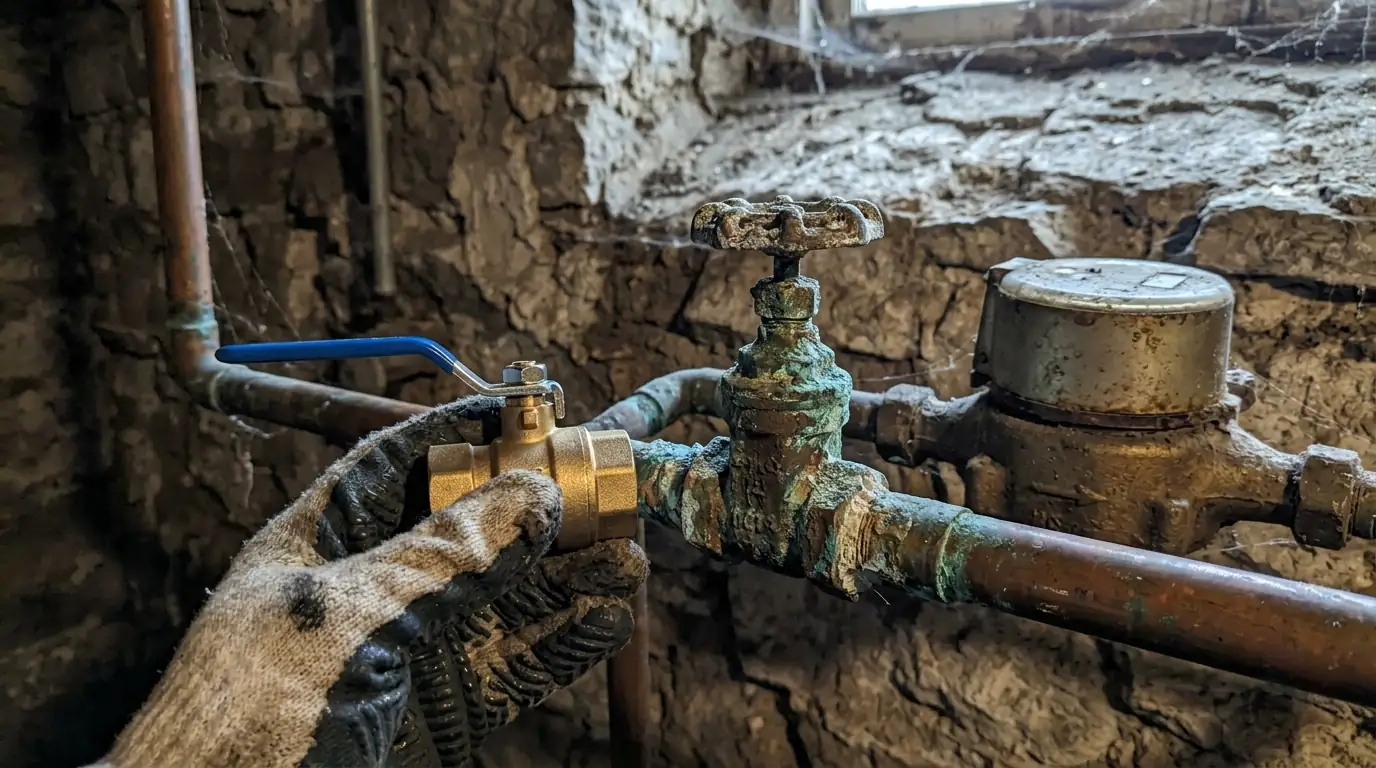
Many pre-1960 homes still have gate valves, the type with a round wheel handle that you turn many times to close. Inside, a brass wedge slides down into the pipe. After decades of sitting open, mineral deposits build on the wedge and stem, and the packing around the stem dries out. When someone finally tries to close it, the stem may snap, the wedge may stick halfway, or the packing may start dripping.
Even newer valves wear out. Cheap multi-turn globe valves in 1970s and 80s houses fail in similar ways. A valve that only closes partway is almost as bad as one that won't close at all, because water keeps running into the burst pipe while you wait for help, and the house keeps flooding.
Which signs mean the valve needs replacing?
Some warning signs are visible from across the room, and some only show when you try to use the valve. Look at it carefully without forcing anything. If you see corrosion, water stains on the floor below, or a mineral crust around the stem, plan for a replacement. Then decide whether to test it gently or leave that to a plumber.
A very stiff handle is a judgment call. Forcing a seized gate valve can snap the stem and leave water running with no way to stop it inside the house. If the valve looks old and crusted, it's often smarter to have a plumber test and replace it in the same visit than to risk breaking it yourself.
- A round wheel handle on an older brass gate valve
- Green or white crust around the stem or packing nut
- Drips or dampness at the stem or the joints
- A handle that won't turn or turns without closing the water
- Water still trickling from faucets after the valve is closed
What does a replacement involve?
Replacing the main shut-off means stopping the water before the valve, which usually requires the curb stop, a valve buried near the property line or in the boulevard. In Minneapolis, Saint Paul and many suburbs, the water utility controls the curb stop, so the plumber coordinates with them or uses an approved key. Once the water is off, the old valve is cut out and a new full-port ball valve is installed.
A quarter-turn ball valve closes with a single lever turn and rarely seizes. Many plumbers also add a second valve after the meter so the meter can be serviced without shutting the main again. When PlumbTek replaces a main valve, the meter connections and nearby piping get checked too, since old galvanized or corroded copper often needs a short section replaced at the same time.
- Locate and confirm access to the curb stop with the utility.
- Shut off the curb stop and drain the house lines.
- Cut out the old valve and inspect the pipe on both sides.
- Install a full-port quarter-turn ball valve, plus a second valve after the meter if needed.
- Restore water slowly and check every joint for leaks.
What does main shut-off replacement cost in 2026?
In the Twin Cities in 2026, replacing a main shut-off valve with straightforward access usually runs about $293 to $687. Adding a second valve after the meter, replacing a short section of corroded pipe, or working around a tight finished-basement closet can push it toward $847 or more. If the curb stop itself is broken, the job grows, since excavation may be involved.
Compared with water damage from a burst pipe that can't be shut off, the cost is modest. Your real cost hinges on access and pipe condition, and you hear it before the water is shut off. Replacing the valve in fall, before cold snaps raise the risk of a frozen and burst pipe, is the smartest timing in Minnesota.
Is this a good time to look at the service line too?
When the valve comes out, the plumber can see the service line material right where it enters the house. In pre-1950 Minneapolis and Saint Paul homes, a dull gray, soft pipe that scratches shiny may be lead. Both cities run lead service line replacement programs, so it's worth checking your address on the city lookup and asking about the service line during the valve job.
Low water pressure throughout the house can also trace back to a corroded galvanized service line or a partly closed old valve. Sorting these out together saves a second shutdown. To plan a valve replacement, call PlumbTek at (612) 254-6294 and mention the age of your house.
Reader questions
Can I replace a main water shut-off valve myself?
It's not a typical do-it-yourself job, mainly because the water has to be stopped at the curb stop, which the utility often controls. A mistake with an old valve or curb stop can leave water running into the basement with no way to stop it. Most cities also expect a permit for work on the service connection.
How often should I test my main water shut-off valve?
Turning a newer ball valve closed and open once or twice a year keeps it from sticking and confirms it works. With an older gate valve, gentle testing is reasonable only if it looks clean and moves easily. If it's stiff or crusted, have a plumber test it so a snapped stem doesn't create an emergency.
What if the main shut-off breaks during a burst pipe?
Call the water utility's emergency line to shut the curb stop, and call a plumber who answers 24/7. While you wait, open the lowest faucet in the house to drain pressure, turn off the water heater, and move belongings away from the water. Once the water is off, the broken valve can be replaced.