The short version
- Test the pump in early March, before snowmelt and spring rain arrive.
- A frozen or blocked discharge line can sink a working pump.
- Check valves, float switches and power supply fail more often than motors.
- A battery backup is worth it for any finished basement that has flooded before.
Why does spring thaw hit Twin Cities sump pits so hard?
All winter, snow piles up against the foundation and the top of the ground stays frozen. When March and April warm up, that snow melts faster than frozen soil can absorb it, so the water runs along the surface toward the house and down into the drain tile. Add a spring rain on top of a melting snowpack and the sump pit can fill within minutes.
In Anoka County, Blaine and other north metro areas with sandy soil and a high water table, groundwater itself rises in spring. Some pumps there run every few minutes for weeks. Any weak part, a sticky float, a tired check valve or a frozen discharge, tends to show up on the first warm, wet weekend of the season.
How do you test the pump itself?
Start by making sure the pump has power. Many pumps plug into an outlet near the pit, sometimes through a piggyback plug for the float switch. Check that the outlet works and that a GFCI hasn't tripped. Then remove the pit cover and look for debris, gravel or silt that could jam the float or block the intake screen.
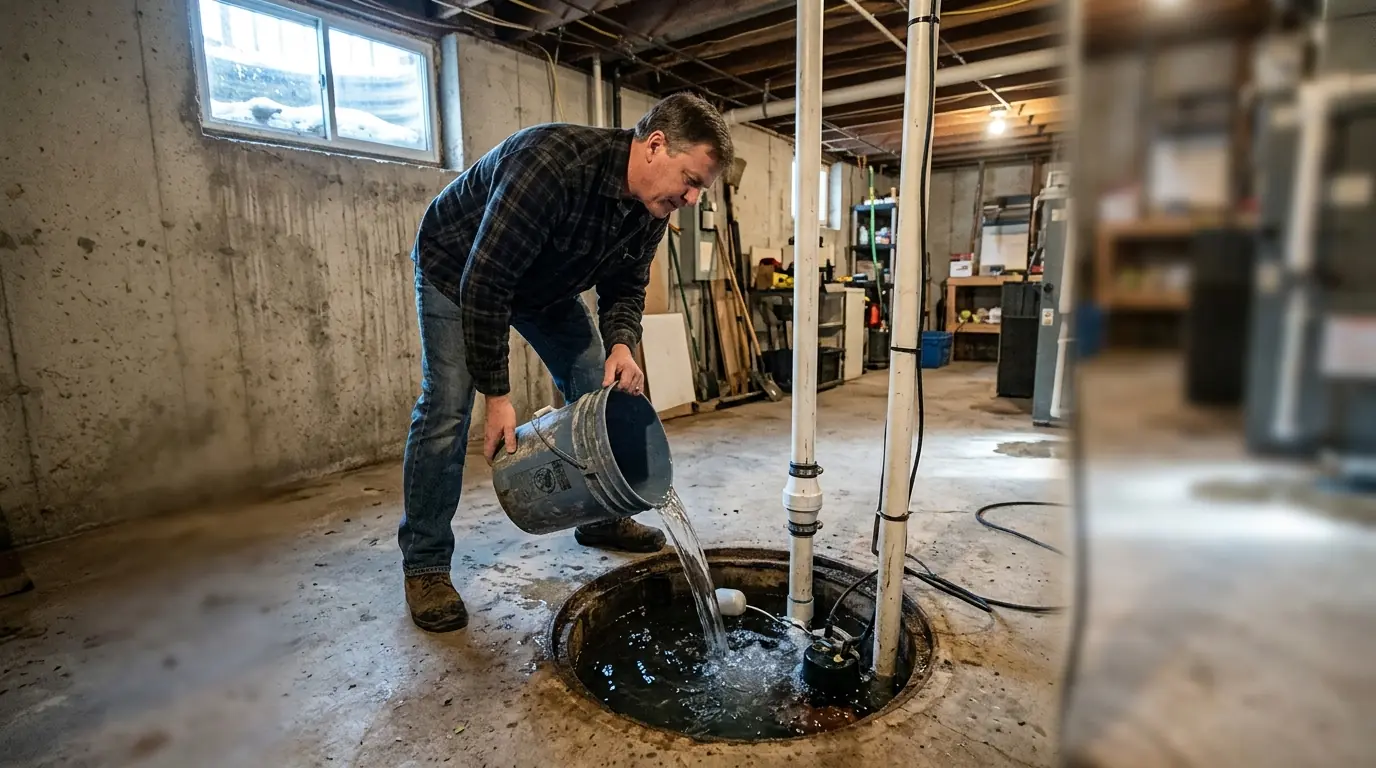
Slowly pour a five-gallon bucket of water into the pit. The float should rise freely, the pump should start without humming or grinding, and the water level should drop quickly before the pump shuts off cleanly. If it hesitates, runs without moving water, or doesn't shut off, the float switch, impeller or motor needs attention before the thaw arrives.
- Confirm the outlet has power and the GFCI is not tripped.
- Remove the pit cover and clear any debris around the pump.
- Pour a bucket of water slowly into the pit.
- Watch the float rise and the pump start without hesitation.
- Confirm the pump empties the pit and shuts off on its own.
- Listen for grinding, rattling or a long hum while it runs.
Why is the discharge line just as important?
A sump pump only works if the water has somewhere to go. The discharge line runs from the pump, up through a check valve, and out through the rim joist or foundation wall. In a Minnesota winter, the outdoor section can freeze solid or get buried under a snowbank, and a pump pushing against a blocked line overheats and fails.
Walk outside and find where the line exits. Clear snow and ice, and make sure the water discharges well away from the foundation on ground that slopes away. A short extension or a buried line to daylight helps, but buried lines need enough pitch to drain so they don't freeze. A freeze-relief fitting near the house gives water an escape route if the outdoor pipe ices up.
Which small parts fail most often?
The motor gets blamed, but smaller parts usually go first. The check valve stops water in the discharge pipe from falling back into the pit after each cycle. When it sticks or fails, the pump reruns the same water over and over and wears itself out. A loud thump when the pump shuts off can mean the valve is closing hard.
Float switches are the other common weak spot. A tethered float can catch on the pit wall or the power cord, and a vertical float can stick with silt. Either way, the pump either never starts or never stops. Replacing a float switch or check valve costs far less than a new pump, so it's worth checking both every spring.
- A stuck or cracked check valve
- A float switch caught on the cord or pit wall
- A clogged intake screen from silt or gravel
- A tripped GFCI or a loose plug
- A frozen or crushed outdoor discharge line
Does your basement need a backup pump?
The worst sump failures happen when spring storms knock out power, exactly when the pit is filling fastest. A battery backup pump sits in the same pit and runs off a deep-cycle battery when the main pump fails or the power drops. A water-powered backup, which uses city water pressure, is another option for homes on municipal water.
If your basement is finished, holds stored items you care about, or has flooded before, a backup is worth pricing. In the Twin Cities in 2026, a primary pump replacement typically runs about $387 to $746, and adding a battery backup system usually falls between $918 and $1,637. Your own number depends on the pit, the pump and the discharge piping, and it is laid out before anything gets swapped.
When should you call a plumber instead of handling it yourself?
Call for help if the pump won't start, runs nonstop, smells of burning, or trips a breaker. Also call if water is entering the pit faster than the pump can clear it, or if the pit is cracked and silt keeps washing in. A pit that's too small for the inflow often needs a larger basin or a second pump, not just a new motor.
If water is already rising toward the floor, unplug nearby electrical items, move valuables up and call a plumber who answers overnight. PlumbTek picks up at (612) 254-6294 at any hour, and urgent sump failures during the thaw are prioritized. A plumber can also check whether a floor drain or backwater valve needs attention at the same visit.
Reader questions
How often should a sump pump be replaced in a Minnesota basement?
There's no fixed date, but pumps that cycle constantly in high water table areas wear out sooner than those that rarely run. If your pump is approaching a decade old, makes new noises, or struggles during the spring test, replacing it before the thaw is safer than waiting for it to fail during a storm.
Can a sump pump discharge into the sanitary sewer in Minneapolis?
No. Minneapolis and most Twin Cities cities generally prohibit connecting sump pumps to the sanitary sewer, because clear water overloads the system and contributes to basement backups across the neighborhood. Sump water should discharge outside onto your property or to an approved storm connection. Ask your city which outlets it allows before rerouting a line.
What sump pump horsepower suits a Twin Cities home?
Many Twin Cities homes do well with a one-third or one-half horsepower submersible pump, but the right choice depends on how much water enters the pit and how high the pump has to lift it. A plumber can watch the inflow during wet weather and check the vertical lift to size the pump correctly.